
Premier Tony Wakeham of Newfoundland and Labrador has stated that political factors have influenced his choice to omit a public referendum on the new Churchill Falls agreement, despite earlier commitments.
During his campaign in the previous provincial election, he pledged to hold a referendum regarding any agreements related to Churchill Falls. On Monday, alongside Prime Minister Mark Carney and Quebec Premier Christine Fréchette, Wakeham introduced a new agreement but confirmed that it would not be subject to a referendum. He acknowledged that many people might feel “disappointed” by this decision.
“The situation has evolved significantly now that the federal government is involved. Such involvement was never envisioned in the previous memorandum of understanding or prior to that,” Wakeham explained in a phone call to CBC Radio’s The St. John’s Morning Show on Wednesday.
He noted that with the federal government urging prompt action, the “facts on the ground” have shifted over the past year, particularly in light of the U.S. trade conflict.
U.S. President Donald Trump has temporarily halted 50 percent tariffs on Canadian products for three days, which were set to begin on August 19, while discussions about a trade agreement continue.
“We are faced with the possibility of even more U.S. tariffs, and that threat remains,” Wakeham remarked.
The House of Assembly is scheduled to convene on September 14 for a special debate, and Wakeham assured that Members of the House of Assembly (MHAs) will have the necessary resources to review the specifics of the agreement. He mentioned that the negotiating team would also be available.
This new deal supersedes a 2024 memorandum of understanding established by the former Liberal provincial government, which a subsequent review commissioned by Wakeham’s administration concluded was not beneficial for the province.
The PC caucus previously walked out during the voting process for the earlier memorandum.
When asked if the opposition might similarly exit, Wakeham pointed out that they had previously supported the earlier memorandum and asserted that the current proposal is an improvement.
“This is a new and enhanced deal, offering more power, greater value, and increased transmission capacity,” he stated.
Wakeham also noted that an advantage of the new agreement is the possibility for Newfoundland and Labrador to sell power to Quebec or retain surplus energy for local industrial use. He emphasized that Ottawa’s participation enhances the current memorandum, particularly with the prospect of a 2,000-megawatt onshore wind energy project in Labrador, where Ottawa may take a 40 percent equity stake that Newfoundland and Labrador could repurchase later.
-
Ottawa coming to the table in new hydro MOU is a big deal, says former civil servant
-
Without the full details, N.L.’s opposition, Innu Grand Chief not entirely sold on new Churchill agreement
Additional advantages comprise loan guarantees for the Gull Island hydroelectric initiative, which will assist in reducing borrowing costs, investment tax credits, and Ottawa’s support in constructing the Labrador Transmission Line, he noted.
“Collectively, these factors represent over $3.5 billion in investment from a federal government that is partnering with us,” he added.
With a potential Quebec election on the horizon, there could be a new administration in place. Wakeham expressed that while he cannot control that situation, he believes the agreement is advantageous for both provinces.
He expressed hope for finalizing the definitive agreement by the end of the year.
‘Tenuous geopolitical world’
Charlene Johnson, CEO of Energy N.L., attended the announcement on Monday and expressed pride in Newfoundland and Labrador’s “natural resources that are the envy of the world.”
Her members are eager for the extensive work opportunities that the energy initiatives could create, spanning engineering, fabrication, on-site construction, and ongoing operation and maintenance.
“We are looking forward to all these opportunities throughout the full lifecycle of this project,” Johnson remarked.
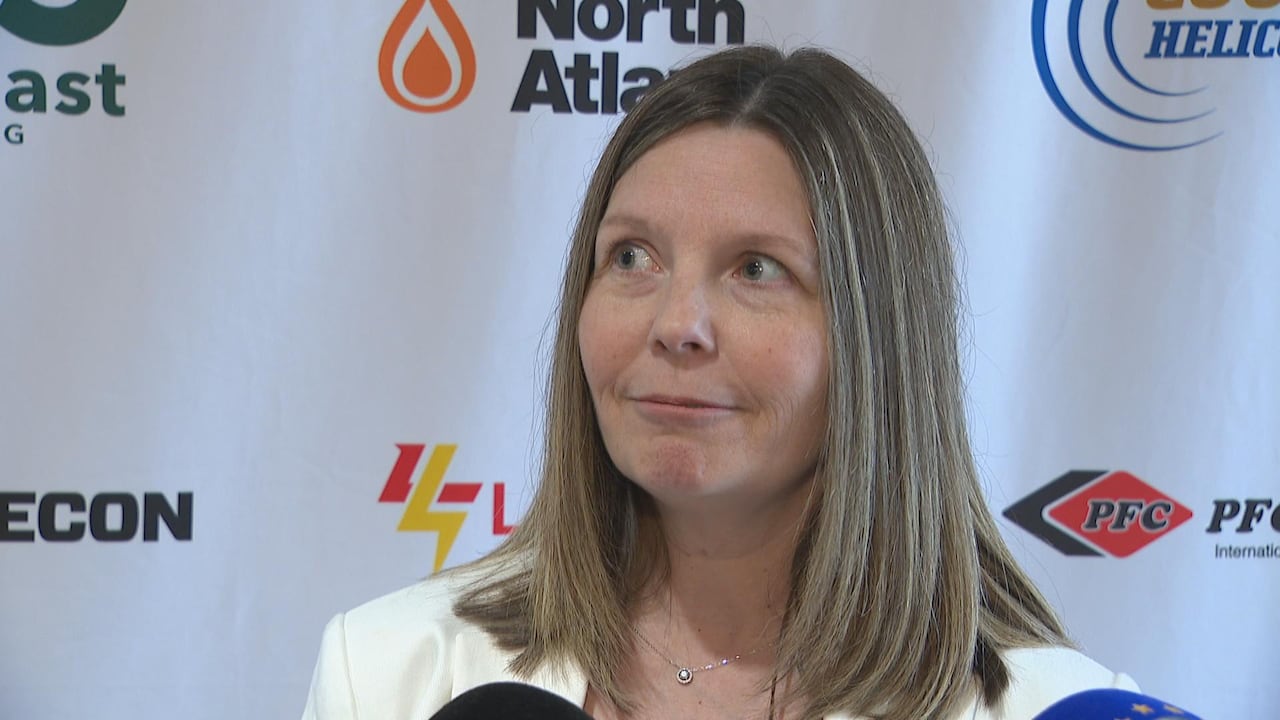
Energy N.L. CEO Charlene Johnson says her members are eager to work on all aspects of the projects. (Danny Arsenault/CBC)
She also commented that Carney referring to it as the largest clean energy investment in North American history is “quite significant.”
“The world is in urgent need of energy, and Newfoundland and Labrador possess the resources and expertise to provide it,” Johnson noted. “We are all acutely aware of the precarious geopolitical environment we currently inhabit.”
Download our free CBC News app to sign up for push alerts for CBC Newfoundland and Labrador. Sign up for our daily headlines newsletter here . Click here to visit our landing page.