
Ratko Mladic, who was found guilty of genocide for masterminding the 1995 massacre of over 8,000 Muslims in the worst atrocity in Europe since World War II, has passed away.
His lawyer Dragan Ivetic confirmed that Mladic died in UN custody on Thursday, though he did not disclose the cause of death. Ivetic stated that the former general had spent his final months in the hospital section of the UN detention facility located in a suburb of The Hague.
The massacre at Srebrenica marked the horrifying climax of a conflict that raged for more than three years, during which Mladic relentlessly bombarded the besieged capital of Sarajevo daily with artillery, tanks, mortars, and heavy gunfire from his nationalist Serb army, resulting in 10,000 fatalities.
In July 1995, the victims from Srebrenica were buried in mass graves over a span of four days, with some remains exhumed and relocated to remote mountainous areas in an attempt to conceal evidence of the atrocities.
The United Nations International Criminal Tribunal for the former Yugoslavia (ICTY) determined that the intent behind these actions was “ethnic cleansing,” aimed at forcibly removing Bosnian Muslims, Croats, and other non-Serbs to make way for a Greater Serbia.
The tribunal concluded that Mladic, along with Serbian President Slobodan Milosevic and Bosnian Serb political leader Radovan Karadzic, participated in a criminal conspiracy to execute this plan.
At an ICTY hearing regarding his case in 2014, Mladic, who was labeled the “Butcher of Bosnia” by his adversaries, stated, “I do not recognize this court.” When sentenced to life imprisonment in 2017, he vehemently proclaimed that it was “all lies.”
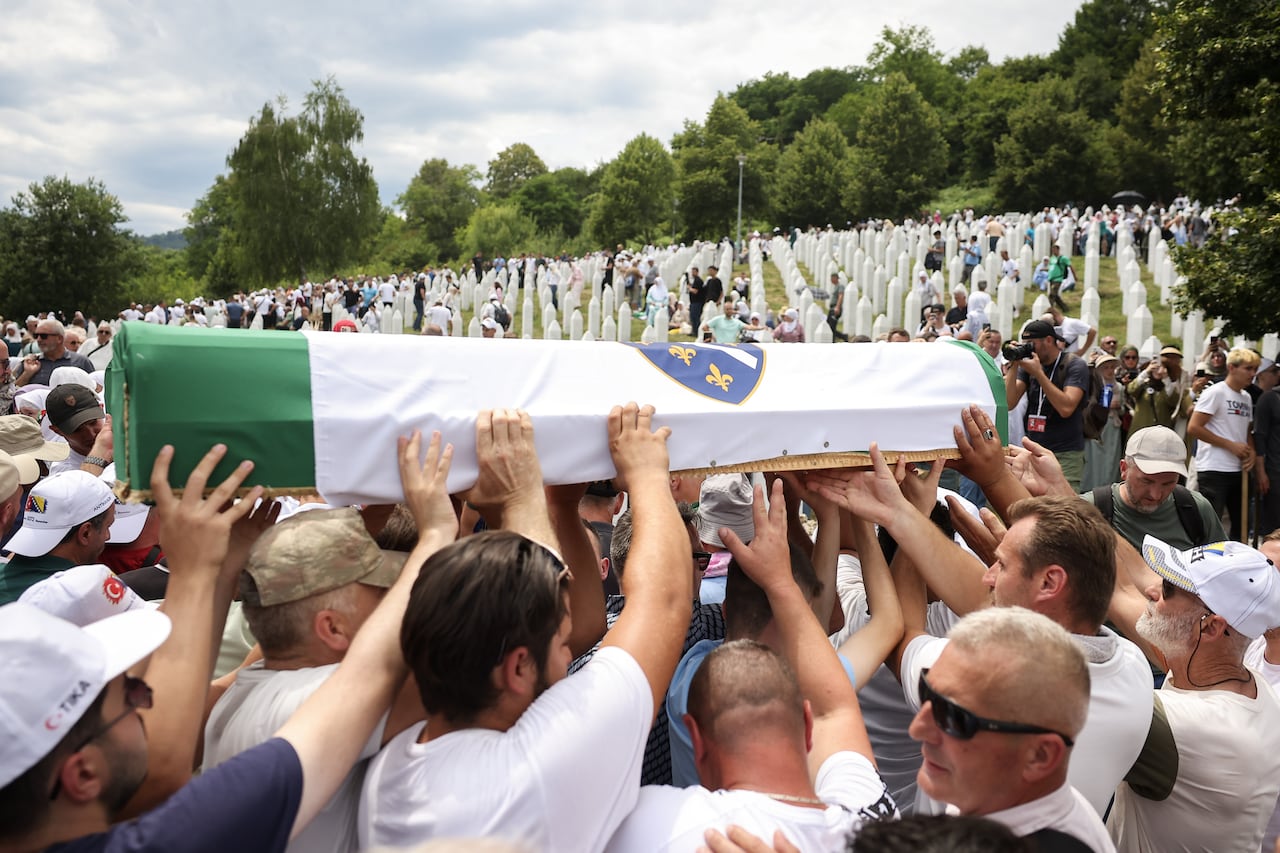
Bosnian Muslims carry coffins containing remains of 10 newly identified victims of the Srebrenica massacre, during a mass burial ceremony in Potocari, Bosnia on July 11. (Armin Durgut/The Associated Press)
Karadzic, who was also convicted of genocide in 2016, alongside Mladic, was among the top individuals sought by the ICTY for many years following the conclusion of the war. Nevertheless, Mladic lived comfortably—albeit discreetly—in Belgrade until Milosevic was overthrown by a popular uprising in 2000.
Milosevic died in custody on March 11, 2006, just months before a verdict was reached in his four-year trial concerning genocide and other war crimes in Croatia, Bosnia, and Kosovo.
Taunted peacekeepers
The military Mladic commanded during the Bosnian conflict was characterized by its brutality. In some of the most heinous acts, prisoners were suffocated from heat after being forced to consume salt without access to water; they were starved and sexually assaulted in prison camps; some were compelled to leap off bridges and were shot; and hundreds were executed at night after being driven from detention with chemical gas.
“For me, Mladic represents the embodiment of all the terrible crimes that occurred during the war—our daughters were raped, and our sons killed, solely because they were Muslim,” remarked Munira Subasic, whose son and husband fell victim to Bosnian Serb forces after the capture of Srebrenica.
Mladic had a cameraman document the assault on the besieged enclave of Srebrenica, berating Dutch UN peacekeepers who naively accepted his assurances that the residents would be safe under his control. Srebrenica was designated as a “safe area,” intended to shield civilians from ethnic cleansing.
“We present this town as a gift to the Serb people,” Mladic declared on camera, framing the victory as retribution against the Muslim Turks, who previously governed the region during the Ottoman Empire.
When NATO attempted to restrain his forces in 1995 through the threat of limited airstrikes, Mladic’s troops defiantly captured UN peacekeepers, using them as human shields by chaining them to potential targets.
In November 1996, Mladic and his senior generals succumbed to intense Western pressure to resign as mandated by Bosnian Serb President Biljana Plavsic, who had taken over from Karadzic and was later imprisoned for her involvement in war crimes.
According to his son, Mladic was born in 1943, although official documents recorded his birth a year earlier.
He was an officer in the former communist Yugoslav People’s Army (JNA) at the onset of Yugoslavia’s disintegration in 1991.
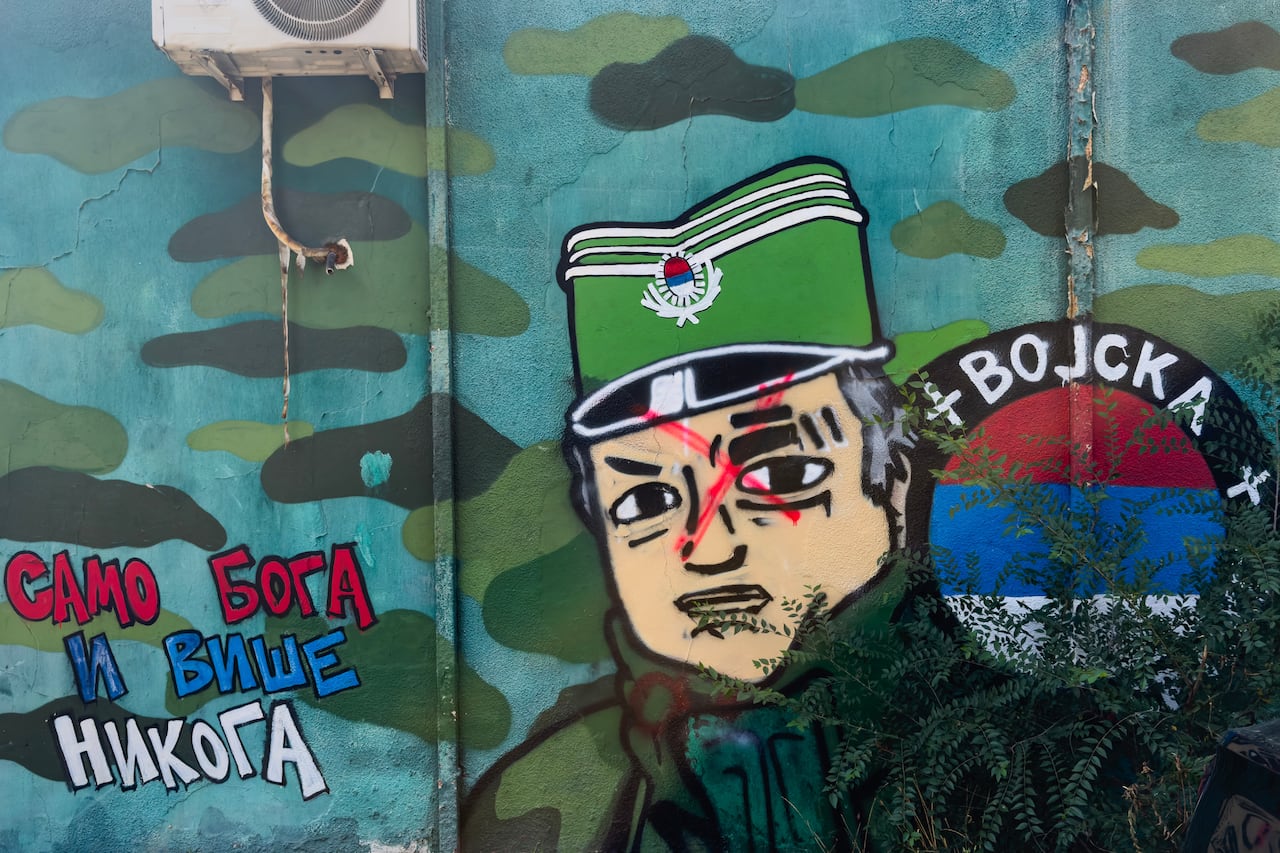
A defaced mural depicting Mladic is shown in Belgrade on Thursday, with a Cyrillic inscription reading, ‘Only God and no one else.’ (Andrej Isakovic/AFP/Getty Images)
When Bosnian Serbs rebelled in 1992 against Bosnia’s Muslim-led declaration of independence, Mladic was appointed to lead the newly formed Bosnian Serb army that quickly captured 70 percent of the country.
Numerous towns were besieged using heavy artillery that had once belonged to the JNA, and villages were set ablaze while 22,000 troops from the UN Protection Force remained virtually powerless, restricted from taking sides.
Western pressure, covert American aid in the form of arms and training for Croats and Muslims gradually shifted the dynamics against Mladic’s forces. Determined NATO airstrikes completed the transformation.
Despite calls from the West, the reformist leaders in Serbia following Milosevic’s downfall did not dare to take action against a man revered by a significant faction of nationalist Serbs.
Upon his eventual arrest in 2011, Mladic did not resist. His right arm was paralyzed, presumably due to an untreated stroke. He appeared markedly different from the robust general of the mid-’90s.
In 2013, he suffered a heart attack and seemed much older than his actual age. He described himself as feeling like a frail old man.
His appeal against his conviction was denied in 2021, along with multiple requests for release on compassionate grounds, including those made in recent weeks.