
On Wednesday morning, U.S. President Donald Trump announced that “massive” exploration for oil, gas, and minerals is expected to commence in “our new and beautiful Greenland.”
It was not immediately apparent what specific exploration or developments Trump was referencing, as Greenland operates as a self-governing territory of Denmark, and is not part of the United States.
Following a campaign event in Wasilla, Alaska, where he backed Republican U.S. Senator Dan Sullivan in his bid for a third term against Democratic former congresswoman Mary Peltola, Trump shared his remarks on the Truth Social platform.
Escalating energy costs—stemming from Trump’s conflicts in Iran—are imposing significant and ongoing financial difficulties on working-class Americans ahead of the upcoming midterm elections next month. Trump’s statements on Wednesday likely aim to address voter apprehensions before they cast their ballots.
However, despite Trump’s enthusiasm, companies have faced challenges in resource exploration and extraction in Greenland for decades. The island’s severe climate, insufficient infrastructure, and complex geology have hindered progress. Previous attempts to extract rare earth minerals, along with oil and gas, have remained at the exploratory phase.
Recent agreement does not provide exploration rights
Trump’s remarks regarding the Arctic territory come less than a month after he finalized an agreement with Danish and Greenlandic leaders aimed at enhancing security in the Arctic and North Atlantic, following tensions with NATO allies over his persistent requests for the U.S. to take control of the semi-autonomous Danish territory. The agreement does not confer any special exploration rights to the U.S., but it does impose restrictions on investments from non-NATO countries in strategic sectors.
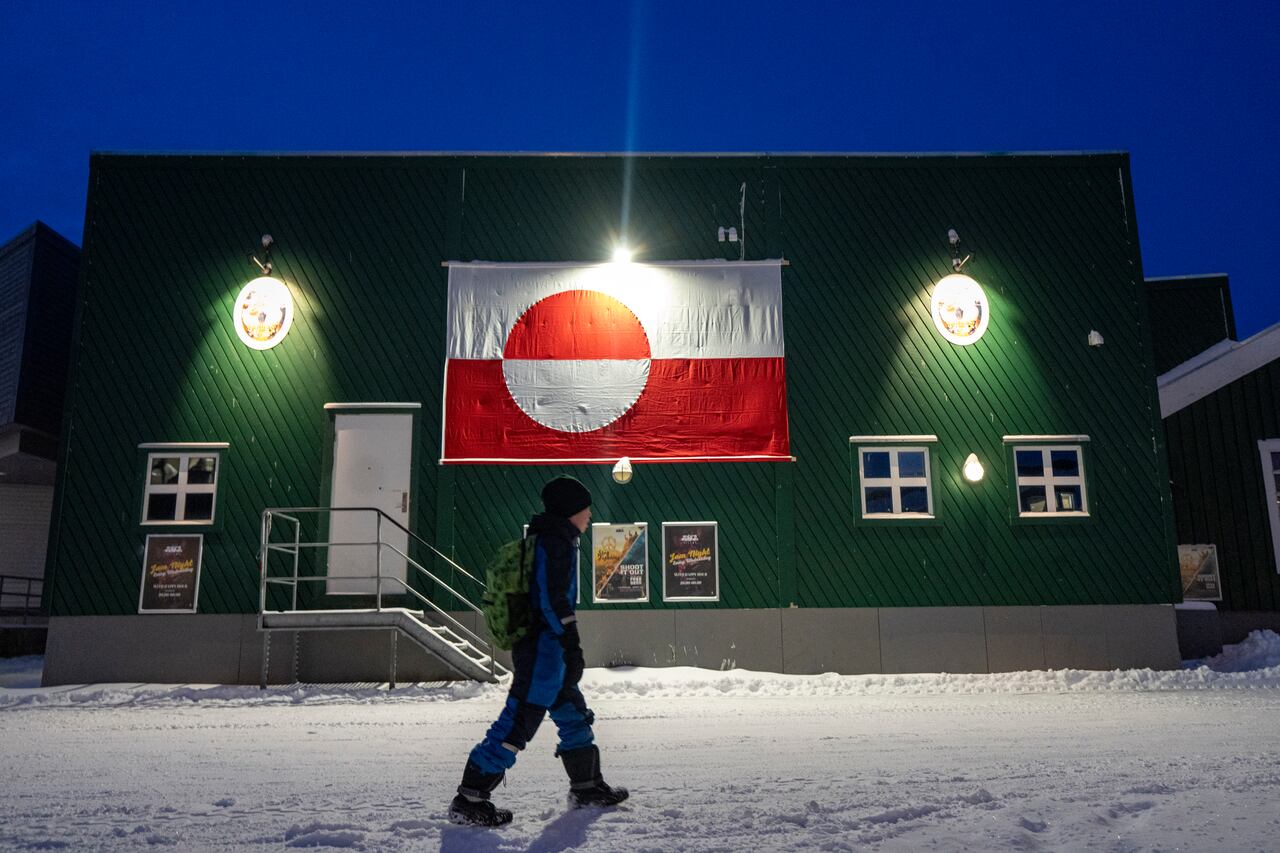
A young boy walks in Nuuk, Greenland on Friday, Feb. 6, 2026. The self-governing Danish territory has consistently rebuffed Trump’s calls for the U.S. to annex the island. (Christinne Muschi/CP)
The agreement also facilitated the establishment of additional U.S. bases in Greenland and reduced tensions surrounding Trump’s repeated desires for the territory to join the United States. This agreement would continue to be in effect if Greenland opts for independence in the future.
Since 2019, Trump has shown interest in acquiring Greenland and has, during his second term, issued threats to take the territory from Denmark, a NATO ally.
Requests for comments from representatives of Danish and Greenlandic leaders were not answered immediately on Wednesday.
Greenland possesses valuable resources
Greenland is home to significant deposits of rare earth minerals essential for the production of everything from computers and smartphones to the batteries, solar, and wind technologies that facilitate the transition away from fossil fuels. Currently, China holds a dominant position in the global supply of these critical minerals, and the Trump administration is working to disrupt this monopoly.
The U.S. Geological Survey has also identified substantial potential offshore reserves of oil and natural gas.
Nevertheless, accessing these resources could prove extremely challenging: the rare earth minerals are embedded in rock formations, while offshore oil and gas reserves lie beneath Arctic ice.
Trump highlights Greenland’s strategic importance
In his Truth Social post, Trump emphasized Greenland’s strategic position, asserting that “from a security perspective regarding the defense and offense of both the United States and Europe,” the island is “second to none.”
“Any future assault on the United States will have to traverse Greenland, where our defenses will routinely neutralize drones, missiles, or any other weaponry yet to be conceived,” he stated. “It offers us time, positioning, and sightlines unlike anywhere else globally!”
Historically, the U.S. maintained a significant presence in Greenland, but since 1945, the number of U.S. military personnel has dwindled from thousands across 17 bases and installations to approximately 200 stationed at the remote Pituffik Space Base in the northwest. This base facilitates missile warning, missile defense, and space surveillance operations for both the U.S. and NATO.
Last month, Trump stated that the U.S. would “immediately initiate the process of establishing a substantial military presence in suitable locations,” which includes “constructing two major military bases.”