
Ella Dalling has been waiting for a daycare spot for her nine-month-old daughter Murph since nearly the time of her first ultrasound.
“We placed ourselves on around 20 waitlists throughout Vancouver. Unfortunately, we haven’t received any responses,” Dalling noted.
The Vancouver resident mentions that parents have no option but to either wait or reach out to daycares directly.
Moreover, since British Columbia lacks fee caps for childcare facilities, costs can vary dramatically, ranging from $200 to $2,000 each month.
“When you finally secure a spot at a daycare, the price isn’t your primary concern; you simply need the placement,” she explained.
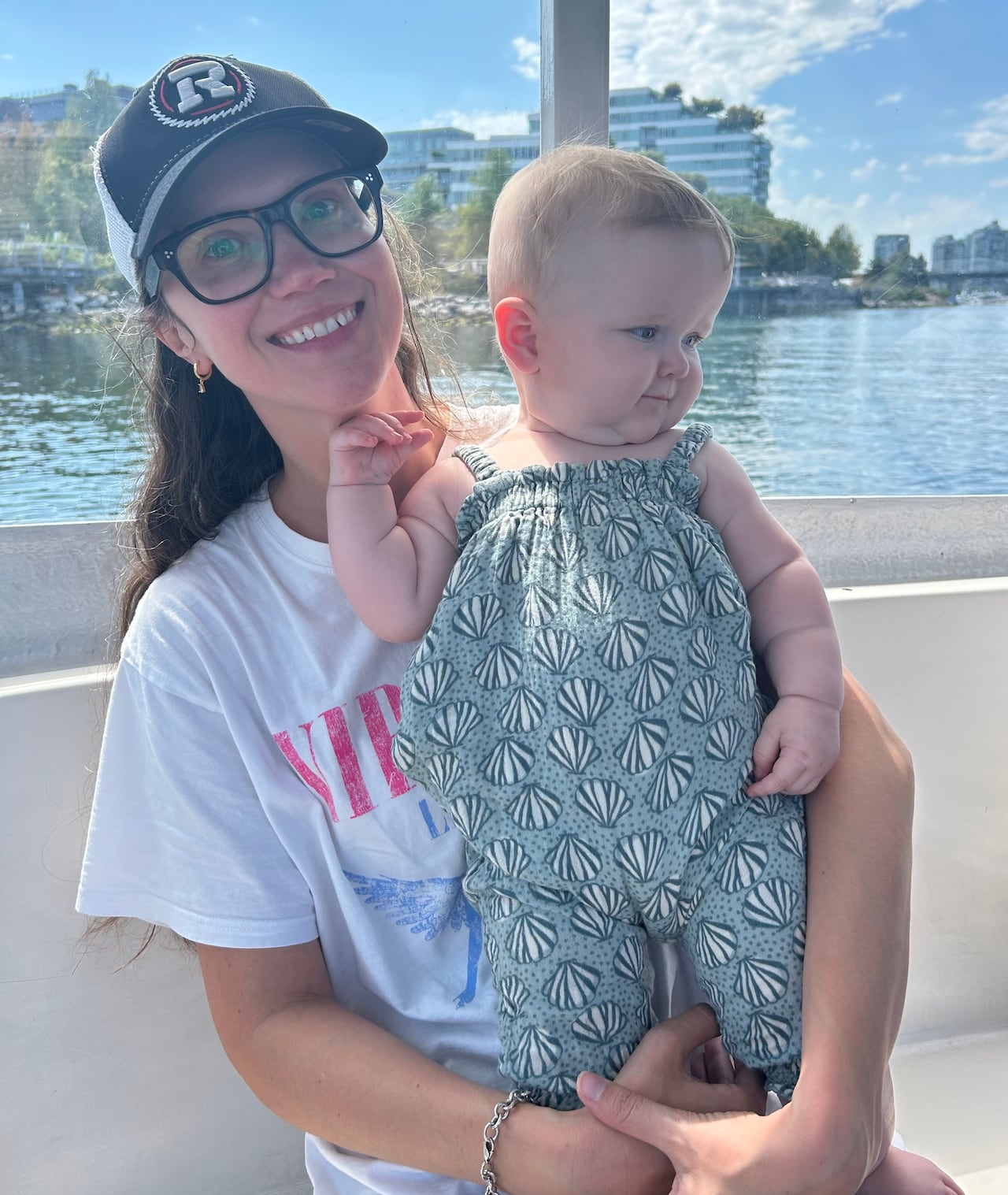
Ella Dalling states that she registered for daycare waitlists while she was expecting her first child. Her nine-month-old daughter Murph still lacks a secured spot. (Submitted by Ella Dalling)
Dalling has created an online service known as Little Scout, which allows daycare facilities to list available spots and helps parents locate options in their vicinity.
Through this venture, she has engaged with parents and childcare providers across British Columbia, all of whom indicate that the existing system requires enhancements.
“When families are contemplating whether to have another child due to the availability of daycare, it clearly highlights an issue,” the Vancouver mother remarked.
A recent report from the Canadian Centre for Policy Alternatives reveals that B.C. is lagging behind other provinces in terms of accessible, affordable childcare.
The region’s childcare framework consists of a blend of private and non-profit providers, with some receiving significant government subsidies while others charge full fees.
David Macdonald, a co-author of the report, points out that parents are posing a straightforward question.
“What will I have to pay for childcare in places like British Columbia?” he inquired. “The answer is quite complex.”
B.C. Child Care Minister Lisa Beare is defending her government’s progress on implementing universal $10-a-day child care, after a number of former B.C. NDP ministers wrote a letter saying the government had stalled on its progress in implementing the policy.
According to the report, B.C. cities rank as the most expensive among 35 studied Canadian cities, with infant fees averaging from $28-a-day in Kelowna to $52-a-day in Richmond.
Macdonald highlights that while B.C. parents are seeing some savings since the province reached an agreement with Ottawa regarding childcare funding in 2021, the monthly savings amount to only $300 to $500. In contrast, parents in provinces with fee caps enjoy much greater savings, he adds.
6 provinces, territories cap fees
Six provinces and territories — Quebec, Newfoundland and Labrador, Prince Edward Island, Manitoba, Saskatchewan, and Nunavut — have established a $10-a-day cap on childcare fees.
In Alberta, parents pay a maximum of $15 a day, while those in Ontario pay $22 a day.
Once viewed as a leader in the movement for $10-a-day universal childcare, a representative for the $10-a-day Child Care Campaign states that the B.C. NDP government has now stalled on the initiative.
“We are falling behind. And that’s precisely what the report indicates,” Sharon Gregson remarked. “Why is it that the B.C. government struggles to achieve what other major provinces have managed in terms of childcare?”

Education and Child Care Minister Lisa Beare was not available for an interview.
In a statement, she expressed concern regarding structural inequities within the $10-a-day program, which is not determined by need but rather operates on a lottery basis.
Consequently, the B.C. government has decided to pause the expansion of the $10-a-day childcare initiative.
“That’s why we are collaborating with families, providers, Indigenous partners, and the federal government to craft a more inclusive, affordable, and sustainable childcare system for the future,” Beare stated.