
Data from both Canada and the United States reveals that cocaine is the most frequently seized drug in southwestern Ontario at the Canada-U.S. border.
During the first half of this year, the Canada Border Services Agency (CBSA) confiscated over 827,000 grams of cocaine valued at more than $82 million at various border crossings, including the Ambassador Bridge, Detroit-Windsor Tunnel, Blue Water Bridge, Peace Bridge, Queenston Bridge, Rainbow Bridge, and Walpole Island.
In the previous year, the CBSA seized a total of 1,631,981 grams of cocaine, while in 2024, the amount confiscated was 1,515,369 grams, with each year’s seizures worth upwards of $150 million.
Justin Morgan, the operational chief with the CBSA at the Ambassador Bridge, stated, “The majority of our operations involve narcotics coming from the United States.”

Justin Morgan is chief of operations with the Canada Border Services Agency (CBSA) at the Ambassador Bridge. (Ken Amlin/CBC News)
U.S. Customs and Border Protection (CBP) officials have also reported that cocaine is the most seized drug at the same southwestern border crossings.
In 2024, they seized 927,142 grams and in 2025, the amount increased to 2,092,875 grams.
A CBP watch commander informed CBC that a significant portion of the cocaine confiscated at the Detroit border is destined for Canada rather than originating from it.
“Inbound issues aren’t as significant,” Lavarah Miller stated. “A lot of what we seize is actually going outbound.”
This year, marijuana seizures by CBP (1,797,133 grams) have greatly exceeded cocaine confiscations (242,218 grams) during the period from October 1, 2025, to July 6, 2026.

Cocaine is appealing to criminal networks because of stable supply, established distribution, a researcher says.
According to Benoît Gomis, a lecturer at the Munk School of Global Affairs and Public Policy in Toronto, seizure data regarding illegal substances doesn’t provide a complete picture.
He stated, “Ultimately, we really don’t know” how much crosses the border without detection.
Furthermore, trends in drug seizures lack context, as they “could imply various things,” according to Gomis.
“It could indicate that law enforcement had some lucky breaks with larger confiscations,” he noted.
“It might also suggest an increased political will to target a specific substance, or that there is an actual rise in drug availability.”
Why is cocaine so appealing to criminal networks?
Gomis explained that the plant used to produce cocaine primarily grows in Colombia and Peru, providing a “very stable source.”
This stability is a key factor that makes the drug attractive to criminal organizations, he added.
“Cocaine has always been present; there’s a well-established playbook for them. It’s a relatively easy substance to smuggle due to its small size,” Gomis stated.
“There’s a consistent demand, and the distribution networks are well-established.”
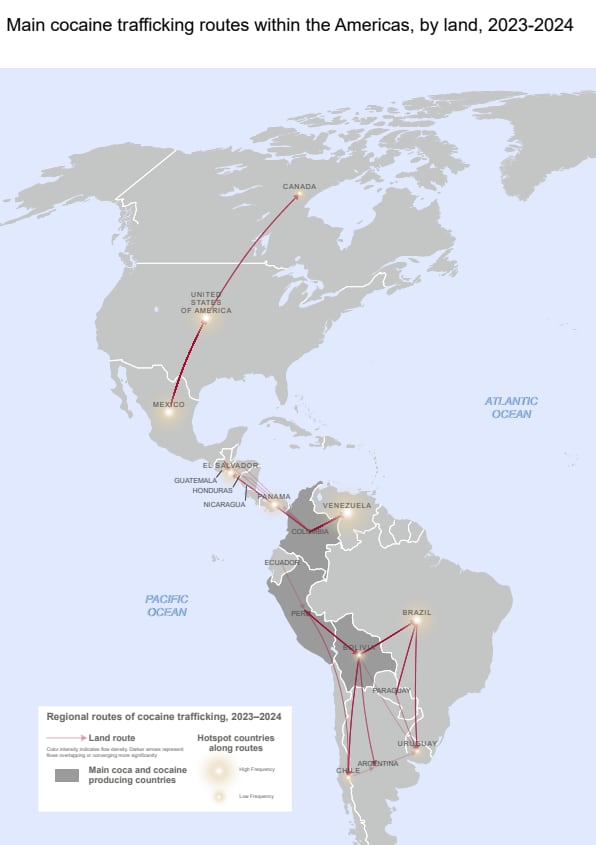
An image from the United Nations Office on Drugs and Crime shows the main, land-based cocaine trafficking routes within the Americas in 2023-24. (United Nations)
Based on his findings, Gomis noted that cocaine usage seems to be on the rise, with estimates suggesting that two to three percent of the adult population has consumed the drug within the past year.
“We have also uncovered anecdotal evidence indicating that the drug’s purity is also on the rise, particularly in the U.S., Canada, and Western Europe, which is leading to various harms,” stated Gomis.
“The drug’s toxicity and potential lethality have been increasing. Furthermore, it is often mixed with other dangerous substances, including fentanyl and various other drugs.”
The United Nations Office on Drugs and Crime releases information regarding global drug trafficking, labeling it as a “clear threat” worldwide.
It emphasizes the damage cocaine has inflicted in Canada, citing a 2018 statistic that indicated it was the most frequently reported substance among individuals entering treatment in the country.
Recent data from 2020 to 2023 indicates that cocaine trafficking operations initiate in the Andean nations of South America, moving north through Mexico into the U.S. and eventually into Canada.
How does Canada detect drugs at the U.S. border?
The CBSA granted CBC News unique access to the Ambassador Bridge port of entry to demonstrate its drug detection methods at the border.
In certain instances, it relies on its own intelligence or information from other law enforcement agencies to identify suspicious incoming shipments for automatic inspection.
Morgan explained, “This enables our officers to recognize various trends and concealment techniques employed by transnational organized crime groups.”
“Transnational organized crime groups have thought of and used every method you can imagine,” he added.
Morgan mentioned that CBSA officers are also trained to identify verbal and non-verbal cues, issues with commercial documentation, and other suspicious signs.
The CBSA has various tools to aid its officers, such as detector dogs, large-scale imaging systems, a mobile X-ray truck, and handheld devices capable of detecting items like firearms inside vehicles before a thorough search is conducted.
Canada’s new border crossing has new detection tech
The newly opened Gordie Howe International Bridge, which became operational on July 27, features 24 inspection lanes, the highest number at any Canadian port of entry.
This new crossing allows CBSA officers to conduct more thorough examinations of commercial trucks, thanks to onsite X-ray technology; they no longer need to unload a trailer, which can take many hours, according to officials.
The Gordie Howe Bridge includes examination bays that are absent at the Ambassador Bridge, as well as smaller-scale X-ray capabilities on the inside.
“We also have a specialized facility within this commercial examination area designed to safely inspect packages that may contain highly toxic substances, such as fentanyl or methamphetamine,” explained Sydney Kale, the CBSA district director for the Gordie Howe International Bridge.