
On Thursday, rescue teams were engaged in extensive searches for numerous individuals reported missing along the Nepal-Tibet border. This follows a devastating surge of water and mud that inundated communities a day prior, triggered by a glacier’s collapse.
According to officials from Nepal and China, over 390 fatalities have been confirmed, and more than 1,400 individuals remain unaccounted for, as reported by The Associated Press. Reuters provides a slightly lower death toll, stating at least 359 have died, with nearly 1,000 missing, including individuals from various nations, due to the sudden floods that struck on Wednesday morning local time.
Anita Anand, the Minister of Foreign Affairs, stated that the government is “aware of 30 Canadians and permanent residents in Nepal and the Tibet region whose current status and safety have not been verified.” She cautioned that this figure may fluctuate given the challenging conditions, including communication disruptions.
A family member of Dhaval and Megha Shah, a couple from Port Moody, B.C., confirmed they are among the missing Canadians.
Nikita Shah, Dhaval’s cousin, mentioned that the couple was undertaking a “spiritual journey” in Nepal and the last communication they received was on Tuesday night.
Shah noted that the couple was residing at Hotel Kailash.
“We are uncertain about the status of the infrastructure, as there has been a lot of misinformation. It would be beneficial for the Canadian government to provide assistance,” Shah expressed. “The Canadian government must take action regarding this.”
Global Affairs Canada announced that it is dispatching five consular officials to Kathmandu to assist Canadians and liaise with local authorities.
The statement added, “We are collaborating closely with our Nepalese and Chinese counterparts, as well as coordinating with international partners and allies who have citizens in the region.”
The Nepal Tourism Board, which has tracked the number of missing individuals from various nations, previously indicated that 25 Canadians were among those unaccounted for.
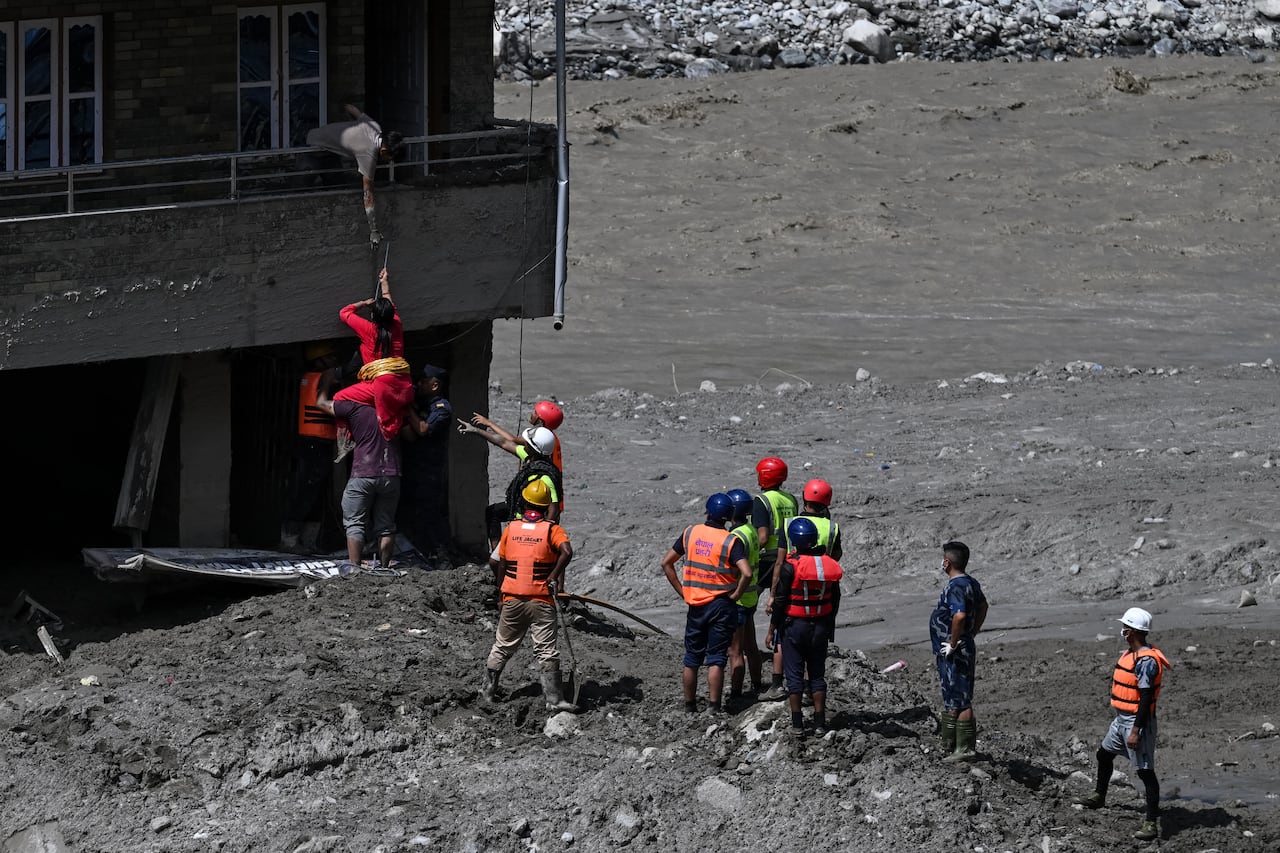
Police personnel rescue stranded residents from houses lying deluged in sludge after flash floods at Trishuli in Nepal’s Nuwakot district on Thursday. (Arun Sankar/AFP/Getty Images)
The steep valleys in the region serve as vital economic routes, yet they become treacherous during disasters. Images revealed that the second stories of buildings in Nuwakot were coated in mud after the deluge. Debris was seen dangling from tree branches and wires, vehicles were buried, and some shocked survivors were covered in mud.
“When I arrived at Dhunge bazaar, within half an hour, the flood struck and destroyed the entire market. People were getting ready to leave for work at that time,” recounted resident Shoyam Rajbhandari. “We have no idea how many are missing or dead.”
UN taps into emergency fund
Tom Fletcher, the United Nations’ humanitarian chief, announced on Thursday that he has authorized the release of $2 million US from the UN’s Central Emergency Response Fund to aid in providing medical assistance, shelter, and water.
He also mentioned that emergency teams have been deployed, with additional teams on standby.
Most of the fatalities, along with 826 of the missing individuals, were reported in Nepal, while three deaths and 558 missing were noted in Tibet, according to authorities. The Nepal Tourism Board stated that 517 of those unaccounted for in the country were foreigners, with 178 of them hailing from India.
-
Flash floods kill more than 160 in Nepal, Tibet
-
Video
Hundreds of people, including tourists, missing after flood in Nepal
Moreover, a spokesperson for China’s Ministry of Foreign Affairs, Lin Jian, reported that nearly 100 Chinese nationals were missing on the Nepal side.
Nepalese officials indicated that numerous bridges had been destroyed and nearly 40 kilometers of roads were damaged, further complicating the search operations.
On Thursday morning, the Nepalese army rescued over 100 individuals from flood-stricken areas using helicopter operations, as stated by army spokesperson Brig. Gen. Raja Ram Basnet.
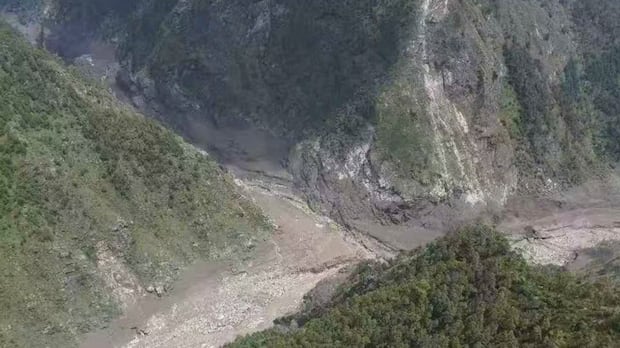
An entire river valley along the Nepal border was wiped out in seconds… but local radar showed no rain, and it wasn’t an earthquake. CBC Meteorologist Johanna Wagstaffe breaks down how a massive glacier collapse triggered a violent inland tsunami—and why geologists warn this unfolding climate disaster isn’t over yet.
At least eight foreign nationals were airlifted to Kathmandu, he added, noting that military teams also rescued individuals trapped within facilities associated with the Trishuli hydropower project.
Rescue teams discovered bodies approximately 100 kilometers downstream from the disaster site in Chitwan district. Many injured individuals have been transported to Kathmandu for more advanced medical treatment.
Bishal Kumar Bhandari, chair of the Nepal Red Cross Society, stated that they have shifted their focus from rescue operations to extensive relief efforts in the affected areas, reporting that around 1,200 individuals have been displaced from at least three villages.
In Tibet, a mudslide that occurred near the Gyirong Port border crossing on Wednesday left areas with mud depths averaging more than 1.5 meters, with some road sections exceeding two meters, according to Chinese state broadcaster CCTV. Roads leading to the port were severely damaged, and secondary collapses or landslides could happen as rainfall continues in the region.
Increasing glacier melting events
The U.S. Geological Survey (USGS) initially detected a magnitude 4.4 earthquake early Wednesday, roughly 66 kilometers north of Kathmandu, near the border.
Later, the USGS revised its findings, indicating that the seismic event measured was a magnitude 5.2 glacier collapse that sent debris flowing downstream, causing catastrophic effects on local communities. This conclusion was based on data obtained from nearby seismic stations, long-period seismic waves, and satellite imagery, confirming that no earthquake had occurred.
Experts in climate science at the International Centre for Integrated Mountain Development in Kathmandu suggested that an avalanche resulting from a glacier was likely responsible for the flash flood that occurred on Wednesday.
“Hydrological studies show the remarkable speed and force of the flood wave,” they stated in an emailed communication, highlighting that at one point on the Trishuli river, water levels surged by as much as nine meters within half an hour.
The Lhende Khola River, a tributary of the Bhotekoshi, experienced the most severe flooding, they reported.
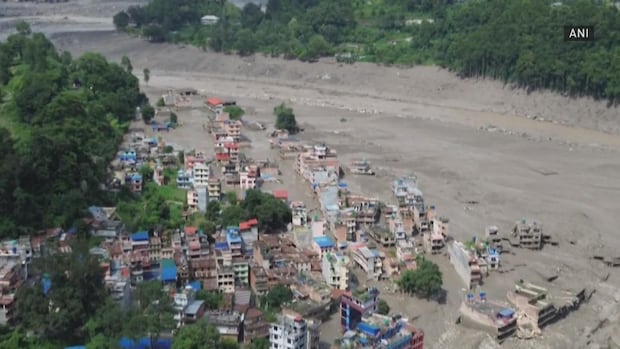
Video captured by a drone shows the impact of floodwaters in parts of Nepal’s Nuwakot district, where some riverside buildings were left surrounded by mud.
The steep hillsides and fertile valleys beneath the Himalayan mountain range, which spans multiple Asian nations, are particularly susceptible to flooding and landslides. The incidence of melting glaciers has increased due to global warming driven by human activities.
Research conducted in Kathmandu earlier this year indicated that glaciers within the Hindu Kush Himalaya region are melting at an accelerated pace, with rates of ice loss having doubled since 2000.
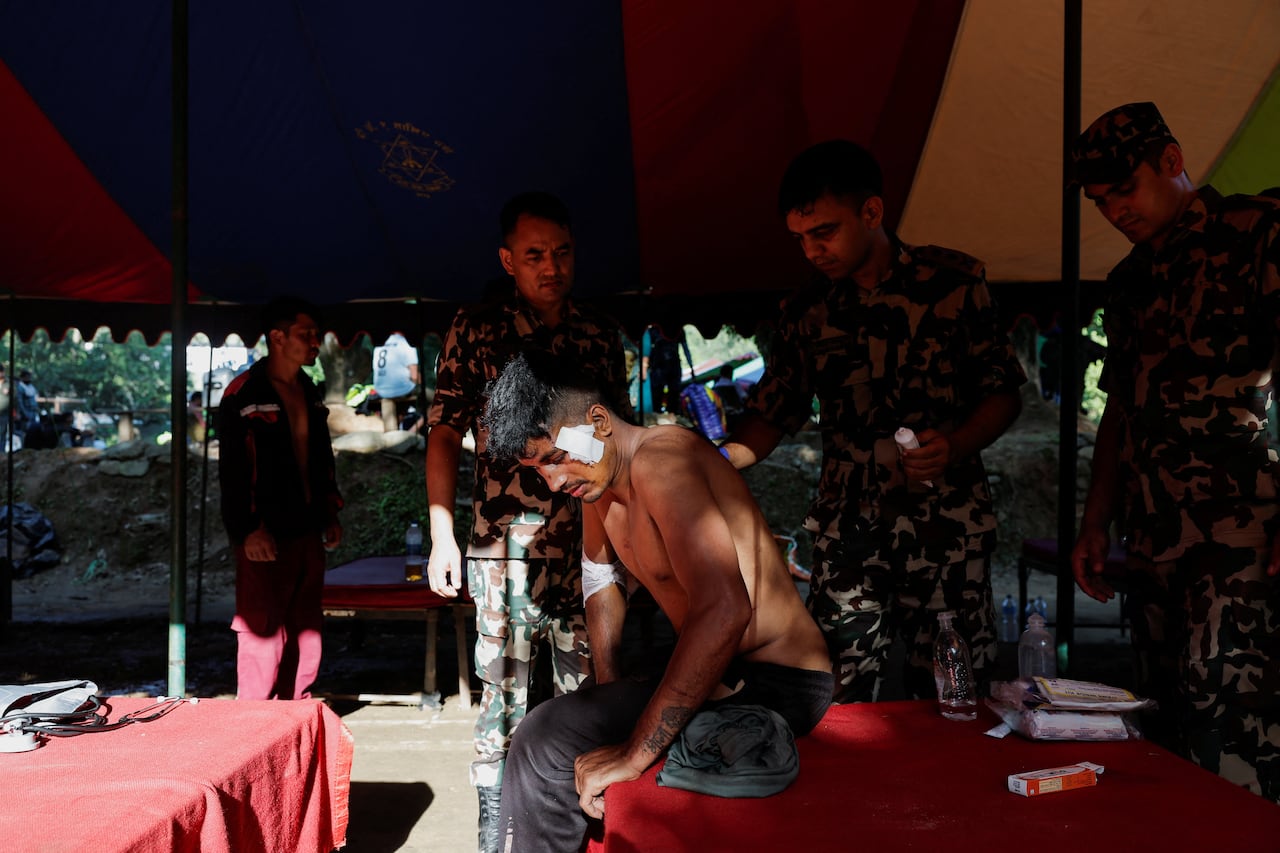
A man who was airlifted from Rasuwa district receives first aid at a mobile hospital staffed by army personnel in Trishuli, in Nuwakot district, Nepal. (Navesh Chitrakar/Reuters)