
Dominic LeBlanc, Canada’s Trade Minister, announced that the federal government “appreciates” the United States “withdrawing” its stance on matters concerning the French language and culture. This follows comments made by U.S. Trade Representative Jamieson Greer to CBC News, stating that Canada’s streaming regulations do not represent a “red line” for the U.S.
“Canada is pleased that the U.S. is retracting its positions on discoverability and labeling, affirming that initiatives aimed at promoting the French language and Canadian culture will not face future U.S. trade repercussions,” LeBlanc expressed in a statement shared on X.
“We anticipate additional constructive clarifications from the U.S. regarding their other positions, which may pave the way for a mutually advantageous trade agreement that honors Canadian sovereignty.”
Last week, Prime Minister Mark Carney instructed his negotiators to exit discussions after the Trump administration introduced conditions related to culture, automotive trade, and sovereignty.
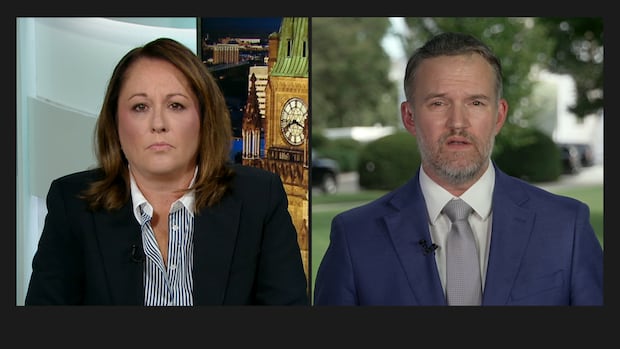
In an exclusive Canadian interview, U.S. Trade Representative Jamieson Greer contested Canada’s narrative regarding the collapse of trade negotiations, stating to CBC News chief political correspondent Rosemary Barton that there are currently no ‘open channels’ for both parties to resume discussions.
The prime minister indicated that the U.S. raised concerns regarding Canada’s support for French cultural initiatives, the dominance of French-language media online, and the requirement for bilingual labeling on products sold within Canada.
“From the outset, it was unacceptable, yet the Americans persisted, and we maintained our stance,” Carney remarked during a press briefing on Saturday.
“Ultimately, it’s straightforward. This was never negotiable for Canada and would not have been acceptable to Canadians.”
Revising stance on culture and language
In an interview aired Wednesday evening with CBC News chief political correspondent Rosemary Barton, U.S. Trade Representative Jamieson Greer seemed to adjust the U.S. perspective on culture and language.
Regarding the discoverability of French content on streaming platforms, Greer mentioned to Barton that it had been “noted” by the White House, although it was not a dealbreaker.
“President Trump, myself, and the U.S. government acknowledge the significance and sensitivity surrounding the French language in Canada, particularly in Quebec, the Maritimes, and certain other regions. We understand that this is a sensitive and crucial matter,” he stated concerning French-language protections.
“There’s no way we would forfeit a beneficial agreement over such an issue. This is not something we are pushing hard on.”
He characterized the U.S. approach to this issue as “allowing capitalism to take its course,” but emphasized that it is “the farthest thing from a red line.”
-
Carney says trade deal became untenable when U.S. ‘asked too much and offered too little’
-
Carney says he’ll resume negotiating when Trump team has the ‘right attitude’
-
Federal ministers announce support for Canadians, counter-tariffs against U.S.
Following the breakdown of discussions, the U.S. imposed tariffs of 50 percent on a broad array of Canadian goods, affecting approximately $27 billion worth of Canadian products.
The U.S. adjusted position emerged just two days after Canada unveiled its own dollar-for-dollar counter-tariffs on over 700 U.S. imports.
While the revised stance on language and culture is a positive development for the potential of a deal between the two nations, Greer informed Barton that the talks are currently nearly non-existent.
He indicated that the timeline for resuming negotiations remains uncertain, confirming that he and LeBlanc were not in communication as of Wednesday.
“At this moment, I would say we do not have open channels,” Greer stated. “I maintain a good rapport with Minister LeBlanc, but presently, it seems the Canadian side is focused on their forthcoming actions.”
Lutnick claims Carney fabricated the issue
U.S. Commerce Secretary Howard Lutnick accused Carney of politicizing the situation by withdrawing from the trade talks, asserting that he never mentioned “French” or Quebec’s language regulations during the discussions.
“Does it matter to America how the Québécois communicate?” Lutnick questioned. “I mean, it’s of no concern to us. We are indifferent.”
This prompted the president to post on social media, stating, “it was a complete lie,” according to Lutnick.
He claimed that this tactic was intended to hinder the sovereignist Parti Québécois (PQ) from succeeding in the upcoming Quebec election.
When approached for a response, PQ Leader Paul St-Pierre Plamondon remarked that if the French language was not genuinely at stake during the negotiations, “that raises a serious concern as it indicates that the Canadian government and Mark Carney have made statements that are not factual.”
However, if Lutnick’s account is inaccurate, “it reflects the true nature of Quebec’s position in those negotiations — that we are not included at the table, but rather we are on the menu,” he stated.
Coalition Avenir Québec Leader Christine Fréchette expressed her trust in Carney’s narrative.
“I perceive sincerity when engaging with our federal counterparts, both politically and administratively,” she conveyed to reporters in French.
Fréchette, who dissolved Quebec’s National Assembly on Thursday to formally kick off the election campaign, noted that the federal government had consistently provided updates about the trade negotiations, particularly in the final 24 hours before they collapsed.
- Do you support Canada’s new retaliatory tariffs on the U.S., set for Sept. 8? Click “Join the Conversation” below. On the app? Tap here.