
At this year’s Paris auto show, Europe’s automotive giants, Stellantis and Volkswagen, showcased their increasing assurance in electric vehicles, drawing insights from their Chinese competitors and collaborators who are currently transforming the local market.
Both automakers are implementing strategic changes to combat the intensifying competition from Chinese firms in Europe, but Stellantis’s announcements on Monday highlighted an expanded potential for collaboration.
-
Stellantis is launching 11 new North American models. Could they be built in Canada?
-
Stellantis talks to build Chinese EVs in Brampton are ‘unacceptable’: Ontario premier
The French-Italian automotive group, which includes brands like Citroen, Peugeot, Opel, and Fiat in Europe, is leveraging its partnerships with Leapmotor and Dongfeng to analyze the technological advantages of the Chinese market, according to Stellantis CEO Antonio Filosa.
“I don’t fully subscribe to the notion that we lack essential capabilities, but there are certainly regions where we can enhance each other’s strengths,” Filosa stated to reporters.
“By collaborating and integrating our engineering teams to find ways to improve, we can pinpoint the sources of competitiveness and learn from them.”
Accelerating with Chinese Collaborators
Earlier this year, Stellantis formed a production alliance with Leapmotor and is also planning another partnership with Dongfeng as part of a strategic realignment under Filosa — these collaborations will be localized to comply with upcoming “Made in Europe” regulations.
The shift towards electric vehicles in Europe has gained momentum recently, driven by rising fuel costs and more affordable options from both Volkswagen and Stellantis’s mass-market brands. Both companies are striving to maintain their market presence against Chinese competitors that are swiftly expanding internationally to offset a slowdown in their domestic market.
“We are witnessing an unexpected rise in the traction of battery electric vehicles (BEVs) that we didn’t foresee a year ago, even in countries like Italy and Spain where BEV adoption has been lower,” remarked Danilo Annese, CEO of Leapmotor International, the joint venture led by Stellantis.
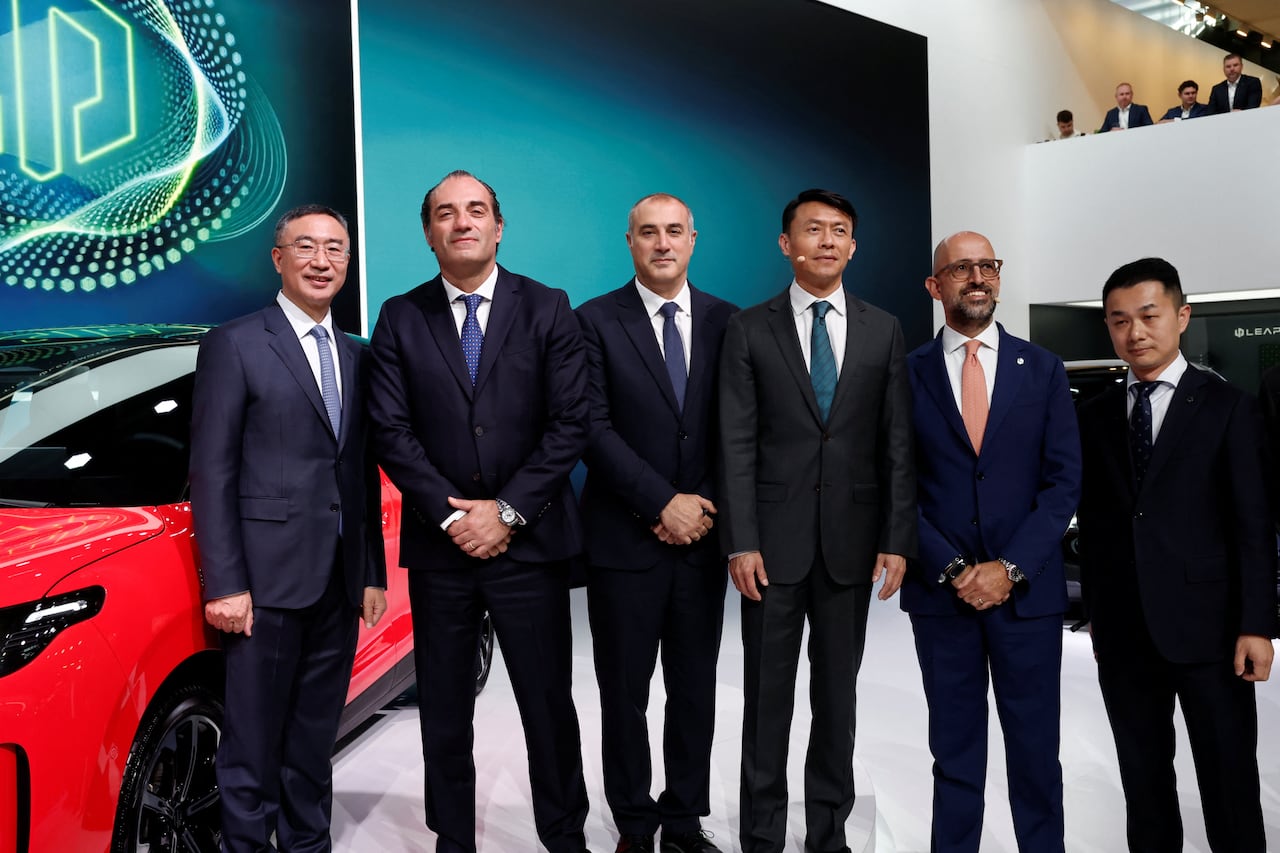
Executives at Leapmotor and Stellantis pose together on the showroom floor of the 2026 Paris Auto, Oct. 12, 2026. (Benoit Tessier/Reuters)
The collaboration between Stellantis and Leapmotor features a mid-sized electric SUV being developed by the Chinese manufacturer in conjunction with Opel, Stellantis’s German brand.
“What I observe is astonishing speed,” remarked Opel CEO Florian Huettl regarding the project, which is a rare instance of a Western automaker directly utilizing a Chinese partner to launch new vehicles in as little as two years.
Additionally, Stellantis unveiled a variety of concept vehicles in Paris as part of Filosa’s initiative to refresh its model range, though Felipe Munoz from Car Industry Analysis highlighted that the pressure remains on the automaker to keep pace with Chinese competitors in a rapidly changing market. “They don’t require concepts. They need production. Now, not in two years.”
The Student Becomes the Teacher
Volkswagen’s transformation has also been significantly shaped by China, which CEO Oliver Blume has referred to as a “fitness center” for the industry.
However, its impact on Europe has been minimal at best. Volkswagen’s collaboration with Xpeng is primarily focused on the Chinese market, while their cooperation in Europe remains largely theoretical — an idea previously proposed by Blume to utilize excess plant capacity, yet no substantial discussions have taken place.
Entering a partnership with Chinese firms in Europe, by allowing them access to underutilized German facilities for instance, could also carry risks, potentially aiding competitors in localizing production in Europe and adhering to regulations intended to safeguard European manufacturers.
-
Canada bet billions on an EV boom. Was it too much, too soon?
-
Volkswagen subsidiary delays opening of $7B St. Thomas, Ont., battery plant to 2029
Blume expressed at an industry conference in Paris on Tuesday that he currently sees no requirement for a joint venture with a Chinese company in Europe.
“So far, we feel well-prepared with the opportunities we’ve developed over the past years in China,” he noted.
Both Volkswagen and Stellantis “are collaborating with Chinese entities in various manners,” stated Stefan Bratzel, an analyst from Germany’s Center of Automotive Management.
While Volkswagen has concentrated on partnerships in China, Stellantis’s alliance with Leapmotor is emerging as a success story within Europe, he added.
Bratzel remarked that European automakers must now recognize China’s role as “a teacher” for the time being. “For years, it was the Chinese who learned from the Germans. Now that process needs to be reversed.”